
Social Ads · Practical learning
A Meta Ad Creative Brief That Gives a Designer Something Useful to Build
Write a specific creative brief with one audience situation, one message, a visual idea and an honest enquiry action.
“Make it premium and high converting” is not a usable creative brief. A designer still needs to know who the ad is for, what the person should understand and which action the business can support. A good brief supplies those decisions while leaving room for visual judgement. This exercise plans a fictional academy demo creative. It does not predict engagement or admissions. The goal is to make an advertisement that communicates a clear, accurate reason to explore the teaching.
Choose one learner situation
The example audience is a college student who has watched marketing tutorials but has not completed a project. That situation suggests a message about doing and reviewing practical work. It is different from a business owner who wants to understand an agency report. Write the situation in one sentence. Avoid adding unsupported income or personality assumptions. The creative should respond to a recognisable task or concern, not a demographic stereotype assembled because it looks thorough in a presentation.
Make the central message concrete
A useful message might be “See how a keyword map becomes a landing-page plan.” It tells the learner what the demo explores. “Become a digital expert overnight” is an inflated promise. Choose the strongest verified detail from the learning experience and keep the main line focused. The caption can add context, but the visual should still communicate the basic idea without a long explanation. If the brief contains five competing messages, prioritise one before asking for design variations.
Describe a visual that demonstrates the message
Show a simple worksheet beside a landing-page sketch, with the connection between them visible. Use real teaching materials where available or clearly illustrative practice assets. A random laptop photograph may fit the topic but does little to demonstrate the course. Do not invent a classroom scene and present it as documentary evidence. For a conceptual graphic, describe the hierarchy, required labels and mobile reading size. Give the designer a clear communication problem rather than a list of fashionable decoration styles.
Keep the action and destination aligned
If the ad invites a demo request, send visitors to a page that explains the demo request and what happens next. Do not imply an instantly confirmed session when admissions must arrange it. Make the destination usable on mobile and check that the form saves the selected request. The ad is only one part of the journey. A visually strong creative can still disappoint if the page changes the offer or hides the next step behind unrelated content.
Define the learning from a variation
Create two versions with one meaningful difference, such as a worksheet visual versus a short lesson clip. Keep a note of the question each version tests. Relevant enquiries and the questions people ask can be more useful than likes alone. Results depend on audience, placement, budget and delivery as well as creative. Present the variation as a hypothesis, then review the evidence. Do not write a success story for an advertisement that has only been mocked up.
Worked example
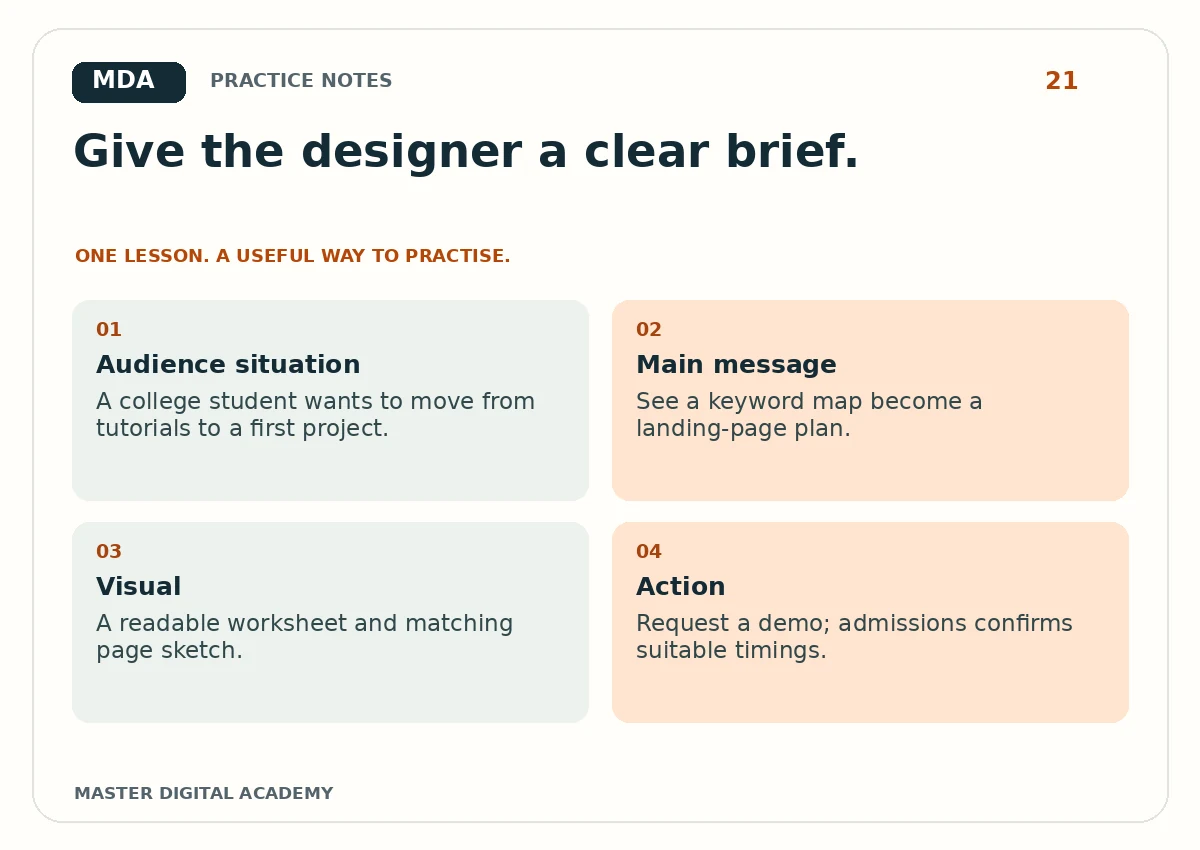
- Audience situation
- A college student wants to move from tutorials to a first project.
- Main message
- See a keyword map become a landing-page plan.
- Visual
- A readable worksheet and matching page sketch.
- Action
- Request a demo; admissions confirms suitable timings.
Try it yourself
Write a one-page brief containing audience situation, message, evidence, visual idea, caption direction, destination and success measure. Produce two rough layouts at mobile reading size. Ask a reader what the ad offers after a three-second glance. If they say “a guaranteed job” when you intended “a practical demo,” correct the promise. Save both the brief and the improved layout as one connected portfolio example.
Questions learners ask
Does every ad need a human face?
No. A clear teaching example can communicate the offer more effectively when it is relevant and readable.
Can I judge a design by likes alone?
Likes are one response signal. Assess the campaign purpose and relevant enquiry outcomes too.
Keep learning
Further reading: Meta Blueprint: learning resources.