
Career Preparation · Practical learning
How to Present a Marketing Project in Five Minutes
Build a concise project presentation that explains the problem, evidence, decisions, work and next test without hiding limitations.
A project presentation is not a tour of every slide you created. It is a short explanation of a problem and the work you did to address it. In five minutes, a reviewer should understand your role, the decisions you made and the evidence behind them. This lesson helps you present a beginner marketing project with confidence and honest limits. You can use it for a course assessment, portfolio discussion or interview without pretending an unlaunched project produced commercial results.
Open with the task and your role
Use the first thirty seconds to explain the scenario, objective and scope. “I planned a quotation page and search-ad message for a fictional cleaning service” is clearer than “I executed an end-to-end growth transformation.” State whether the work was independent practice, a team assignment or a commissioned project. If you collaborated, distinguish your contribution from the team’s work. The listener should not spend the first minute trying to determine whether the campaign ran or which parts you actually produced.
Show the evidence that shaped one decision
Choose the most useful research observation and explain how it influenced the work. Perhaps learners repeatedly asked what happens after submitting a form, so you clarified the confirmation message. If the observation is from a classroom test, say so. Avoid presenting a friend’s feedback as a representative market study. One well-explained evidence-to-decision connection is more memorable than fifteen screenshots of keyword lists. Keep detailed research available for questions rather than forcing every item into the main presentation.
Demonstrate the finished deliverable
Show a readable page section, campaign plan or reporting sheet. Point to the part that solves the problem and explain the reasoning in plain language. Do not display a whole spreadsheet at an unreadable size. If the work includes code or a tool, demonstrate one task rather than explaining every implementation detail. The reviewer needs to see that the deliverable is usable and that you understand its purpose. A polished slide should support the work, not hide an unfinished example behind abstract labels.
Explain what was tested and what remains uncertain
If you checked form saving or ran a small usability exercise, describe the method and observation. If there was no live advertising, say there are no campaign performance results. Present the proposed measurement plan and the assumptions a real test would investigate. This is often where a beginner can stand out: careful limits show that you understand evidence. Avoid filling the gap with a projected chart that looks like actual growth. Label any forecast clearly and keep its inputs visible.
Close with a next step and prepare for questions
Use the final minute to describe what you would test next and why. Then prepare for questions about alternatives, constraints and mistakes. If asked something you do not know, explain how you would find out. Do not recite a rehearsed answer that ignores the question. Practise with a timer and record yourself once. Remove repeated introductions and jargon. A useful presentation feels like a thoughtful conversation about the work, not a rapid reading of every bullet on the screen.
Worked example
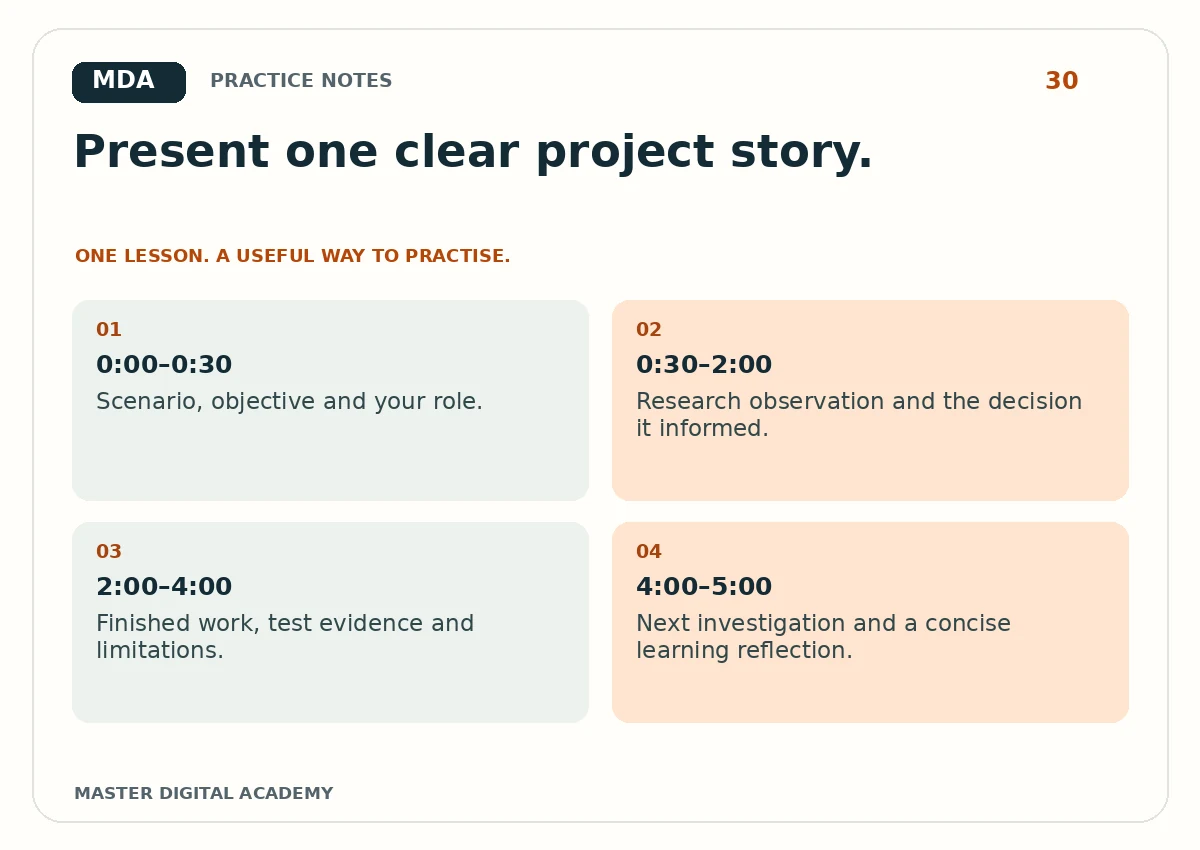
- 0:00–0:30
- Scenario, objective and your role.
- 0:30–2:00
- Research observation and the decision it informed.
- 2:00–4:00
- Finished work, test evidence and limitations.
- 4:00–5:00
- Next investigation and a concise learning reflection.
Try it yourself
Create four slides and a five-minute script for a practice project. Include one readable work sample and one revision. Record a rehearsal, then ask a friend to explain the problem, your decision and the remaining uncertainty. If they cannot, simplify the structure. Prepare three questions you would ask the presenter if you were reviewing the work. Your goal is to explain decisions clearly, not memorise a speech full of impressive terms.
Questions learners ask
Should I hide that the project was a classroom exercise?
No. State the scope and demonstrate the quality of the work within it.
What if I do not know an interview answer?
Say what you know, identify the gap and explain how you would investigate it rather than guessing confidently.
Keep learning
Further reading: MIT Communication Lab: slide presentations.