
AI · Practical learning
AI Ad Copy: Turn a Generic Draft Into a Useful Message With Human Review
Use a specific brief, inspect an AI draft and revise unsupported claims before producing an ad message you can explain.
The most useful AI copy prompt starts before the prompt box. You need a verified offer, a reader situation and a clear destination. Without those inputs, a tool is likely to produce familiar promises that sound relevant but reveal very little. This exercise shows a fictional draft, a review and a revised message for a beginner marketing demo. The example is a writing lesson. It is not evidence of campaign performance or a claim that one prompt can guarantee conversions.
Supply facts and boundaries
Write a short brief stating the audience, teaching activity, action and facts that must not be invented. For example: the demo explains a keyword map and landing-page plan; visitors request a time through admissions; no employment or salary outcome is promised. Add tone and format after the factual boundaries. The model should not be asked to create missing fees, schedules or credentials. A clear brief makes the output easier to review because you can compare it against known requirements.
Ask for distinct ideas rather than endless variations
Request three messages with different useful angles: the project task, the common beginner mistake and the teaching demonstration. Tell the tool to explain the difference briefly. This gives you ideas to assess rather than twenty near-identical slogans. More output is not necessarily more useful. If every draft says “unlock your potential,” go back to the brief and ask what concrete activity is missing. The goal is a message a learner can understand, not a large collection of fluent sentences.
Review the draft against the offer
Suppose the tool writes, “Become job-ready instantly with guaranteed expert mastery.” Mark the unsupported outcomes and the vague phrase. Ask what a learner would actually expect after reading it. The sentence may need replacing rather than softening with a small footnote. Check that the action matches the landing page and that the visual does not imply a confirmed classroom or endorsement. Review is about the whole promise, including images and destination, not only whether the grammar is correct.
Write the improved version yourself
A clearer message might be: “Seen the tutorials? Try planning one real marketing task. Explore how a keyword map connects to a landing-page brief in a practical demo.” This is still a draft for a fictional exercise. The wording describes a useful activity without claiming mastery. The final line can invite a demo request and clarify that admissions arranges timings. Keep the language natural enough to read aloud. If the sentence sounds like an instruction to a model, rewrite it for a learner.
Explain the reasoning and test plan
Record why you selected the message and what you would measure after launch. A campaign may need to test whether the project angle brings more suitable questions than a general course advertisement. Use the same offer and destination when a fair comparison requires it. Do not report imagined click or enquiry results for the draft. Your portfolio can show the brief, rejected copy, review notes and final message. That sequence demonstrates how AI supported the work while a person remained responsible for the claim.
Worked example
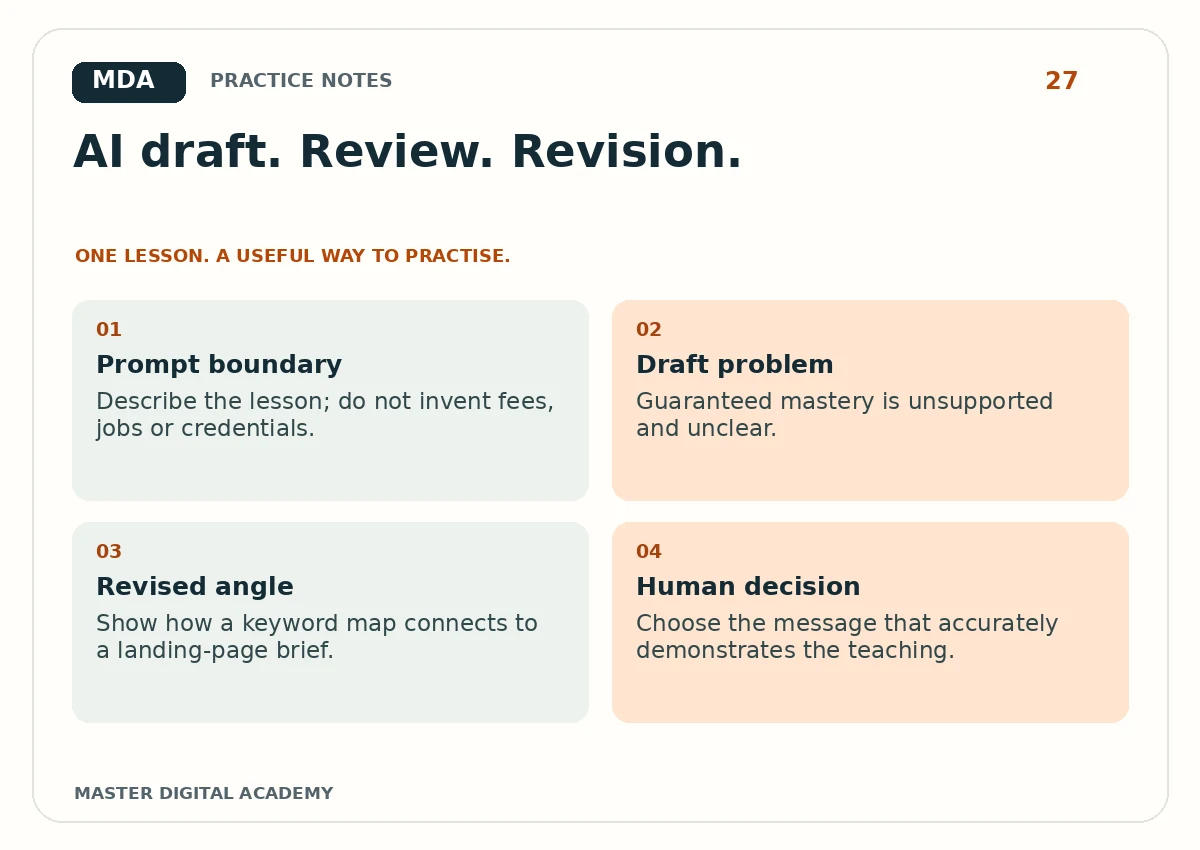
- Prompt boundary
- Describe the lesson; do not invent fees, jobs or credentials.
- Draft problem
- Guaranteed mastery is unsupported and unclear.
- Revised angle
- Show how a keyword map connects to a landing-page brief.
- Human decision
- Choose the message that accurately demonstrates the teaching.
Try it yourself
Write one factual brief and ask an AI tool for three distinct approaches. Highlight every unsupported claim in the output. Select one idea, rewrite it and match it to a landing-page section. Add a short rationale and one measurement question. Keep the complete revision trail. The strongest submission explains why the final message is appropriate; it does not simply attach a screenshot of a prompt and call the task finished.
Questions learners ask
Should I publish the first AI draft?
Check the offer, claims, destination, tone and practical accuracy before publishing.
Can AI review replace human responsibility?
No. Another generated review can assist, but a person needs to assess evidence and approve factual promises.
Keep learning
Further reading: Google: responsible useful content.