
AI · Practical learning
An AI Content Fact-Checking Workflow Beginners Can Actually Follow
Separate claims, source checks and original examples before publishing an AI-assisted marketing draft.
An AI draft can sound certain even when its facts are wrong. The solution is not to ask the same tool whether it is confident and accept the answer. Build a workflow that identifies claims and checks them against suitable evidence. This lesson uses a fictional course description containing invented details. The aim is to learn how to correct a draft without turning a polished writing style into a false statement about fees, teaching, accreditation or results.
Mark claims before improving the tone
Read the draft and highlight every statement that could be true or false. A duration, price, platform feature, trainer credential or performance figure is a claim. So is “guaranteed placement.” Separate these from opinions and illustrative examples. Do this before polishing the prose; attractive wording can make unsupported details harder to notice. Your first deliverable is a claim list, not a better-sounding paragraph. Give each claim a status such as verified, needs confirmation or remove.
Choose the right evidence for the claim
A course fee should come from the academy’s current confirmed information. A software feature should be checked in current official documentation. A student outcome needs genuine records and permission for the intended use. A competitor’s page does not verify your own offering. Keep the source, date and a short note explaining the match. If evidence is unavailable, remove the assertion or state the uncertainty in a way that helps the reader. Do not fill the gap with a more cautious-sounding invention.
Check numbers independently
Recalculate percentages, totals and costs outside the generated sentence. If a draft says 15 enquiries from 300 clicks is a 15% rate, the correct calculation is 5%. Keep numerator and denominator visible. Confirm units, time periods and whether a figure is actual, estimated or fictional. An accurate formula can still mislead when applied to the wrong count. For a practice article, clearly label sample data and avoid presenting it as a result achieved by the academy or a client.
Revise the answer around what remains true
Do not merely delete the most obvious false sentence and keep the original promise intact. If the draft’s central claim was guaranteed employment, the whole paragraph needs a new purpose. Explain the actual learning activities, support and limitations. Add a useful example or exercise that you can substantiate. The revised content should still help a reader make a decision. Honest editing is a writing task as well as a verification task; a page full of vague caveats is not a good replacement for clarity.
Keep a compact review record
Save the draft, claim list, corrections and final version. State who checked what only when that review actually happened. Do not publish an invented expert-review badge. For important or time-sensitive information, assign a future recheck date. A portfolio can show the original error and your correction with an explanation of the evidence. That demonstrates judgement more clearly than claiming that your prompt prevents all hallucinations. Human review reduces risk; it does not make every future output automatically reliable.
Worked example
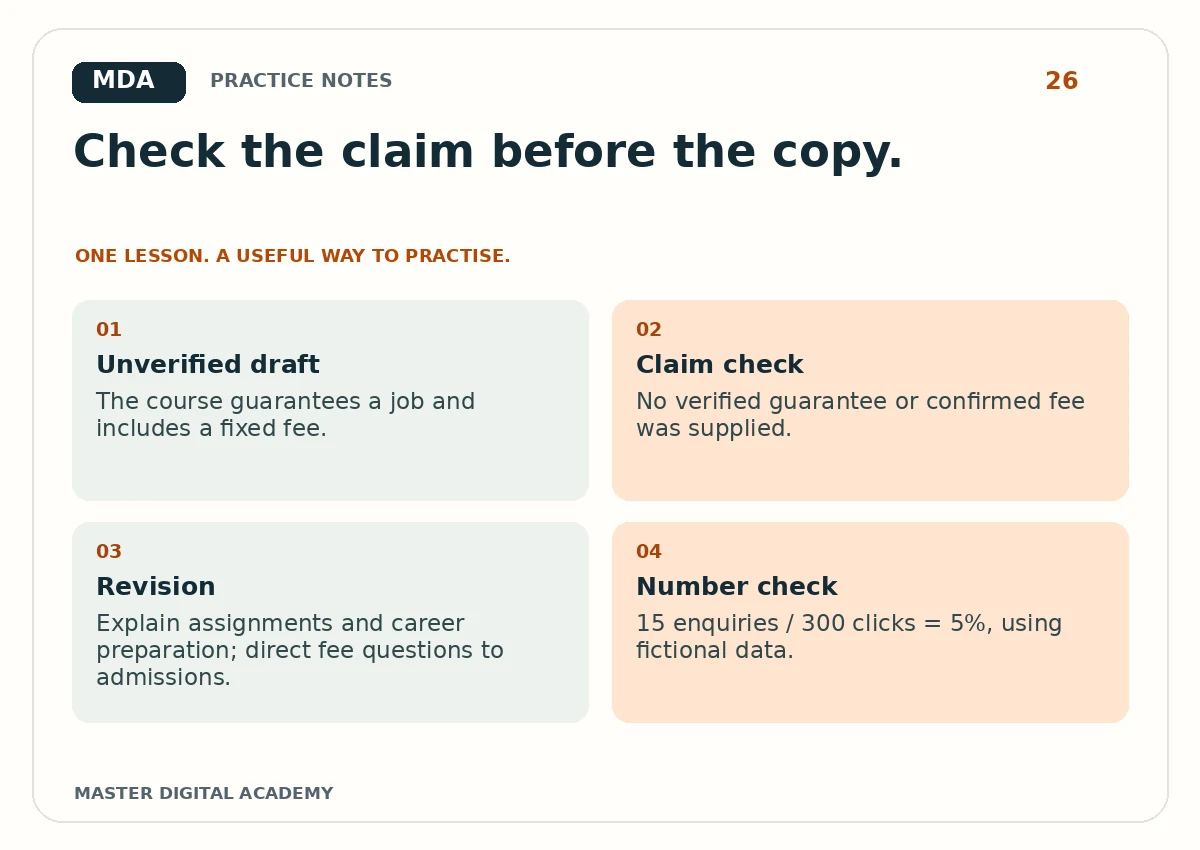
- Unverified draft
- The course guarantees a job and includes a fixed fee.
- Claim check
- No verified guarantee or confirmed fee was supplied.
- Revision
- Explain assignments and career preparation; direct fee questions to admissions.
- Number check
- 15 enquiries / 300 clicks = 5%, using fictional data.
Try it yourself
Take a short AI-assisted paragraph about a course or business. Extract eight claims and assign a status to each. Verify three against suitable current sources, recalculate one number and remove two unsupported promises. Rewrite the paragraph in plain language. Keep a small evidence table explaining the changes. Your final output should be both more accurate and more useful, rather than simply longer or filled with repeated disclaimers.
Questions learners ask
Can an AI tool provide its own citations?
Treat them as leads to check. Open the sources and confirm that they exist and support the exact claim.
Does fact-checking make a draft original?
Accuracy and originality are different. Add your own useful explanation, example or exercise as well.
Keep learning
Further reading: Google: generative AI content guidance.