
Foundations · Practical learning
How to Write an Audience Research Brief Before Choosing a Marketing Channel
Build a useful audience brief from customer questions, buying situations and evidence, with a completed home-service example.
Before you open an ads dashboard, write down the person you want to help and the situation that makes them look for help. “Everyone aged 18 to 60” will not tell you what to put on a page. A useful audience brief connects a real problem to a decision: what happened, what the person needs to know and what would make them enquire. You can practise this without running an advertisement. Start with a business you understand, then separate evidence from your own assumptions.
Start with a buying situation, not a personality
Imagine a fictional sofa-cleaning service called ClearHome. One possible customer has a family gathering this weekend and notices stains on the sofa. Another manages a rented flat between tenants. Both may buy cleaning, but their deadlines and questions differ. Write two separate situations before deciding whether they belong in the same campaign. Keep the description specific enough to influence a message. You do not need an invented name, income or favourite film unless that detail changes the work.
Collect language you can point back to
Read public questions, service enquiries you have permission to use, and competitor FAQs. Record the wording, where it came from and what you think it means. If several people ask whether a sofa will dry the same day, drying time belongs in the brief. Do not turn one comment into a claim about the whole market. Remove personal information from your notes and avoid collecting private profiles. Five useful questions with a traceable source are more helpful than fifty unsupported demographic guesses.
Separate the problem from the purchase barrier
The problem might be a visible stain. The barrier might be uncertainty about fabric damage, price or appointment availability. Those are different jobs for the page. A photograph can help explain the cleaning process, while an honest description of quotation and scheduling answers the purchase questions. Make a column for each barrier and a second column for the evidence the business can actually provide. If the evidence is missing, mark it as something to obtain rather than writing a confident promise.
Turn the brief into a testable message
Choose one situation and write an offer, a supporting explanation and a next step. For the family gathering, you might lead with booking a sofa-cleaning quotation before the weekend. You cannot promise same-day drying unless the business confirms it. List what could make your message wrong: perhaps visitors care more about fabric safety than speed. That becomes a research question. An audience brief should help you choose what to test, not pretend the first idea is already the answer.
Review the brief with someone who handles enquiries
Ask the business owner or admissions adviser which questions customers actually ask. Show them your brief and let them correct it. Pay attention when they say a popular enquiry rarely becomes a customer; that may reveal a gap between interest and fit. Record the correction and its date. If you are practising without business access, label the brief as a hypothesis. Your portfolio can still demonstrate good thinking by explaining which assumptions need validation and how you would investigate them.
Worked example
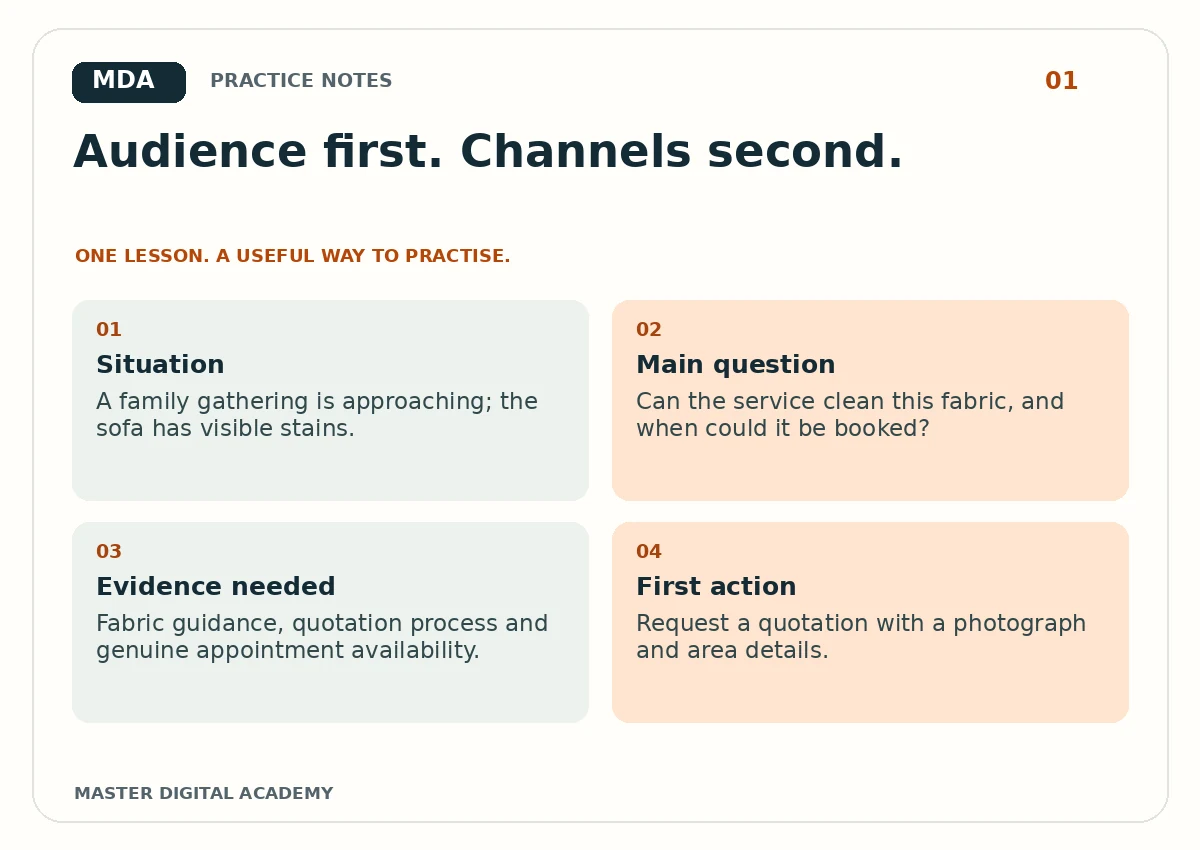
- Situation
- A family gathering is approaching; the sofa has visible stains.
- Main question
- Can the service clean this fabric, and when could it be booked?
- Evidence needed
- Fabric guidance, quotation process and genuine appointment availability.
- First action
- Request a quotation with a photograph and area details.
Try it yourself
Create a one-page brief with six fields: buying situation, problem, questions, barriers, available evidence and next action. Attach three public observations, each with its source. Then write two messages for different situations. Ask a classmate to identify the audience without seeing the brief. If both messages sound interchangeable, narrow the situations further. Keep the original and corrected version so your portfolio shows how research changed a decision.
Questions learners ask
How many customer personas should a beginner create?
Start with one clear buying situation. Add another only when it changes the message, offer or enquiry process.
Can I use AI to produce the audience brief?
Use it to organise notes or suggest questions. Do not treat generated demographics or customer quotations as research evidence.
Keep learning
Further reading: Google: people-first content.