
SEO · Practical learning
Search Intent Mapping: A Beginner Exercise Using a Local Service Business
Group searches by what people want to do, then assign them to useful pages instead of creating a page for every keyword.
A keyword list is not a website plan. Someone searching “how to remove a sofa stain” may want instructions, while someone searching “sofa cleaning quotation” is closer to choosing a service. Both are relevant to cleaning, but they need different answers. Search intent mapping means connecting a query to the job a page should perform. This exercise teaches that decision without pretending every keyword has a fixed intent or that a longer list creates a stronger SEO strategy.
Collect a small, varied set of searches
Choose twelve queries around one service. Include questions, comparisons, prices and provider searches. Use your own observations and search suggestions, then look at the results for the target market. Note whether you see guides, service pages, videos or product listings. Results can change by location and time, so record when you checked them. At this stage you need enough variety to practise grouping. Do not attach invented search-volume or difficulty figures to make the exercise look more scientific.
Describe the next useful answer
For each query, finish the sentence: “This visitor probably needs to…” A stain question may need a safe explanation of what can be tried and when professional help is appropriate. A quotation query needs service scope and a clear way to ask about cost. A comparison query needs meaningful differences. If you cannot explain the visitor’s task, inspect the results again. Mixed results may indicate that more than one intent is plausible. Keep that uncertainty visible in your worksheet.
Group by page purpose
Place similar needs together. “Sofa cleaning near me” and “book sofa cleaning” might fit one service page when the business genuinely serves that area. A fabric-care guide has a different purpose. You do not need separate pages for every spelling, word order or nearby neighbourhood. A page should earn its place through useful content. Creating a dozen similar local pages can make maintenance harder while leaving the original question unanswered. Keep a reason for every proposed URL.
Choose a primary page and supporting pages
Your service page can explain what is cleaned, the quotation process and booking arrangements. A supporting guide might answer preparation questions and link to the service page when help is relevant. Draw that relationship before drafting. If two proposed pages answer the same question for the same visitor, consider combining them. If the service page is turning into a long general textbook, move the detailed lesson to a supporting article and keep a short explanation where buyers need it.
Measure whether the mapping was useful
After publication, look at the queries and landing pages reported in Search Console. Does the service page attract provider searches? Does the guide appear for learning questions? These observations help refine a map; they do not prove a single universal intent. Consider the enquiries as well. A page attracting broad informational traffic may be useful even when few visitors contact the business immediately. Judge it against its purpose rather than expecting every article to behave like a quotation page.
Worked example
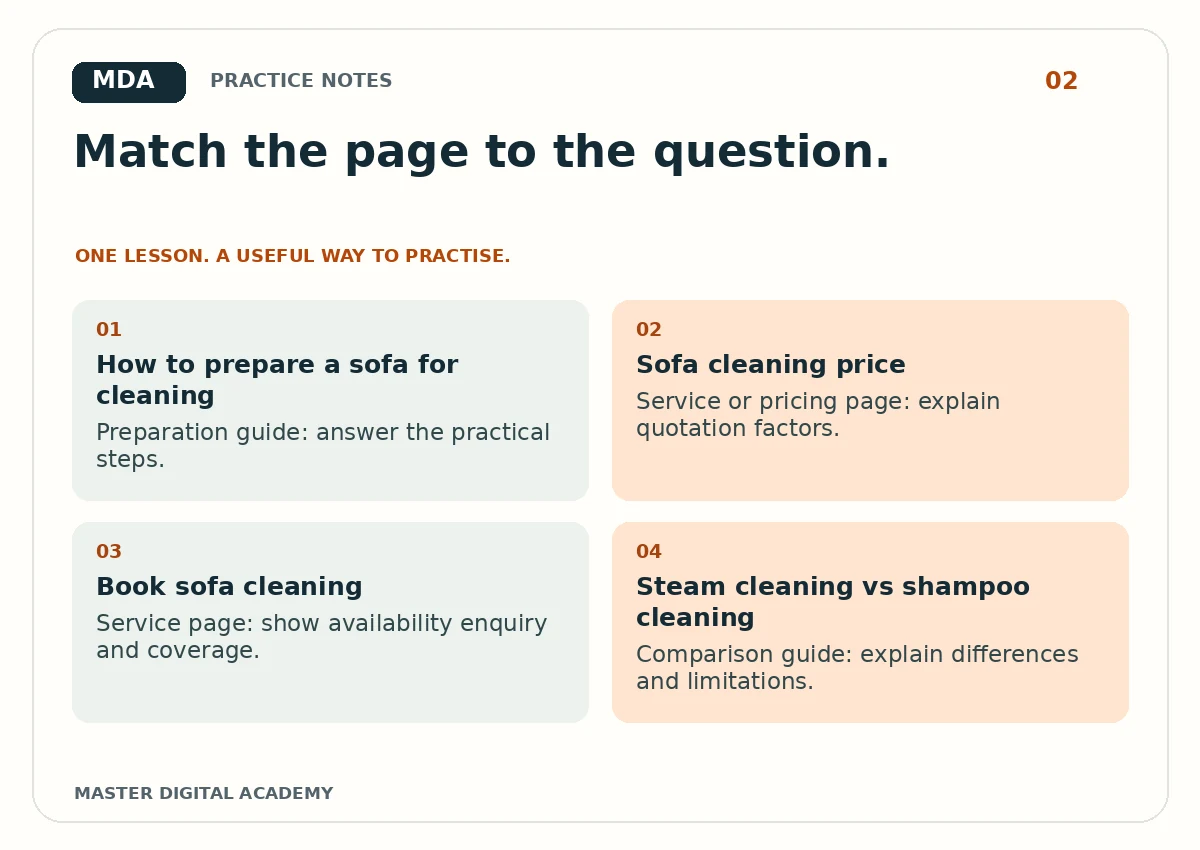
- How to prepare a sofa for cleaning
- Preparation guide: answer the practical steps.
- Sofa cleaning price
- Service or pricing page: explain quotation factors.
- Book sofa cleaning
- Service page: show availability enquiry and coverage.
- Steam cleaning vs shampoo cleaning
- Comparison guide: explain differences and limitations.
Try it yourself
Build a spreadsheet with query, observed result type, likely task, proposed page and reason. Map twelve queries to no more than four pages. Write a unique opening paragraph for each page. Then remove the query column and ask someone to describe the purpose from the paragraphs alone. If the purposes overlap, revise the map before writing more content. Save screenshots of the result patterns as dated research, rather than claiming they will remain unchanged.
Questions learners ask
Can one page target more than one keyword?
Yes. Related searches can belong on the same page when they share a useful purpose.
Does search intent mapping guarantee rankings?
No. It helps organise relevant content. Indexing, competition, authority and the quality of the page still matter.
Keep learning
Further reading: Google: SEO Starter Guide.