
Measurement · Practical learning
CTR, CPC, Conversion Rate and CPL Explained With One Campaign Example
Calculate four marketing metrics from one fictional dataset, then understand what each number can and cannot tell you.
Marketing metrics feel less intimidating when they describe one simple journey. An ad is shown, someone clicks, the visitor enquires and admissions assesses the enquiry. Each metric describes a relationship between those counts and the amount spent. This lesson uses one fictional dataset so you can follow every calculation. It does not offer industry benchmarks. The aim is to explain the arithmetic accurately and avoid celebrating a number without checking what was counted underneath it.
Write down the raw figures
Assume a practice campaign has 10,000 impressions, 300 clicks, ₹9,000 in spend and 15 confirmed enquiries. Of those enquiries, six meet the exercise’s qualification definition. Put these values at the top of the worksheet and label them fictional. Raw counts are essential because percentages without denominators can be misleading. Two campaigns can show the same rate while one is based on ten observations and the other on thousands. Keep the reporting period and counting definitions visible.
Calculate click-through rate and click cost
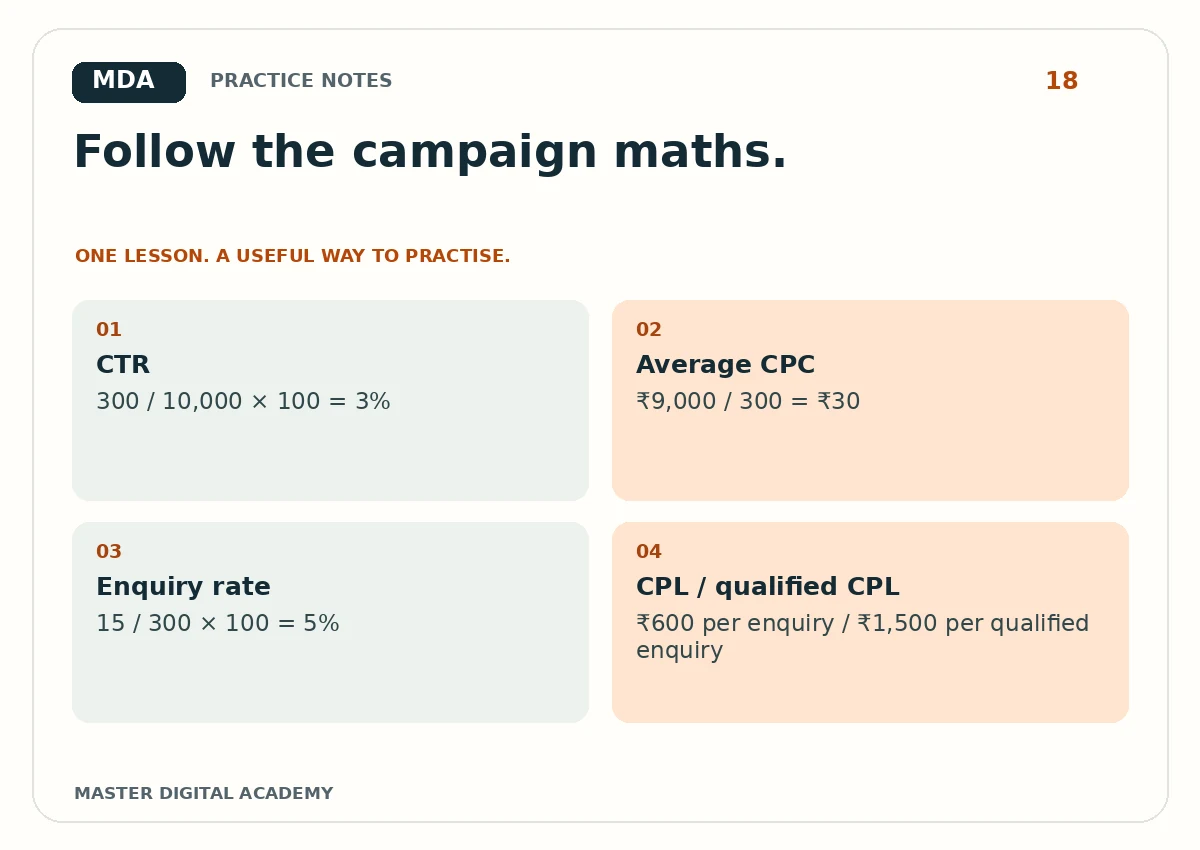
Click-through rate is clicks divided by impressions, multiplied by 100. In the example, 300 divided by 10,000 gives 3%. Average cost per click is spend divided by clicks: ₹9,000 divided by 300 gives ₹30. These numbers describe ad response and click cost, not learner suitability or admissions. If click-through rate rises after a sensational headline, check whether the resulting enquiries remain relevant. A more clickable promise can create the wrong expectation when it overstates the offer.
Choose the denominator for conversion rate
For this exercise, enquiry conversion rate means confirmed enquiries divided by ad clicks: 15 divided by 300 equals 5%. Another report may use sessions or a platform-specific interaction count, so state the denominator. Do not compare rates with different definitions as if they were identical. Also confirm that the 15 enquiries were actually saved rather than inferred from submit-button clicks. A mathematically correct rate can still be operationally wrong when the event being counted does not represent the outcome its label suggests.
Calculate raw and qualified enquiry cost
Cost per enquiry is ₹9,000 divided by 15, or ₹600. Cost per qualified enquiry is ₹9,000 divided by six, or ₹1,500. These are two useful views of the same practice dataset. Qualification needs a documented rule and an unknown category when information is incomplete. A low raw CPL does not automatically produce a low qualified cost. Present both figures and the counts behind them so the team can understand the trade-off instead of choosing a winner from one highlighted cell.
Explain a decision without overclaiming
A beginner report should connect the metric to a question. Low click-through rate may prompt a review of relevance and message. A weak enquiry rate may prompt a check of the offer, page and form. Poor qualification may require clearer expectations or audience review. These are investigation paths, not automatic diagnoses. Small samples, tracking faults and changes in traffic mix can affect interpretation. Write what you know, what you suspect and what evidence the next test should collect.
Worked example
- CTR
- 300 / 10,000 × 100 = 3%
- Average CPC
- ₹9,000 / 300 = ₹30
- Enquiry rate
- 15 / 300 × 100 = 5%
- CPL / qualified CPL
- ₹600 per enquiry / ₹1,500 per qualified enquiry
Try it yourself
Recalculate all four metrics, then change the dataset to 250 clicks and 20 enquiries while keeping spend and impressions unchanged. Explain which metrics improve and which worsen. Next, assume only four enquiries qualify. Write a five-sentence assessment that includes both raw and qualified cost. If a denominator is zero, show the rate as unavailable rather than inventing a percentage or dividing by zero. Keep the raw data beside every derived number.
Questions learners ask
Can I compare conversion rates from different tools directly?
Only after checking event definitions, denominators, attribution and reporting periods.
Which metric is most important?
That depends on the decision. Business outcomes need more context than one advertising ratio.
Keep learning
Further reading: Google Ads: click-through rate.