
Measurement · Practical learning
A Lead-Quality Scorecard That Goes Beyond Cheap Form Submissions
Define a qualified enquiry, score sample records consistently and connect marketing reports to useful admissions conversations.
Two campaigns can deliver the same number of enquiries and create very different work for admissions. One may bring suitable learners who understand the course. Another may bring wrong numbers and unrelated requests. A lead-quality scorecard helps the team describe that difference consistently. It should not become a mysterious score that rejects people automatically. The exercise below builds a small, explainable framework for course enquiries using fictional records and no real student personal information.
Agree on the purpose of qualification
For an academy, useful qualification questions might cover interest in the subject, suitable learning mode, ability to attend and willingness to discuss the course commitment. These are not judgements about someone’s worth or intelligence. Avoid treating English fluency, location or budget as hidden assumptions when the course can accommodate different needs. Ask the admissions team what actually makes an enquiry actionable and document the answer in language another team member can apply.
Separate contactability from fit
A correct number is necessary for a conversation, but it does not prove course fit. A suitable learner may also be temporarily unreachable. Keep contact status and qualification status in separate fields. This prevents a missed call from becoming a permanent “bad lead” label. Include an unknown category rather than forcing every record into good or bad. The scorecard should improve follow-up decisions and reporting accuracy, not encourage the team to fill empty information with guesses.
Use a small number of explicit criteria
Start with three criteria: relevant interest, workable mode and a meaningful next step. Give each a simple status such as confirmed, unclear or not suitable for this offer. Write an example for each status. A person asking for live online classes and a demo may be actionable even before discussing fees. A recruitment enquiry belongs elsewhere. Keep the reason visible beside the classification. A large numeric score can look precise while hiding a weak or inconsistent decision process.
Measure the cost of useful conversations
Suppose two fictional campaigns each spend ₹10,000. Campaign A produces 50 enquiries and ten qualified conversations; campaign B produces 25 enquiries and twelve qualified conversations. Their raw enquiry costs are ₹200 and ₹400, but qualified-conversation costs are ₹1,000 and about ₹833. These are example calculations, not benchmarks. The comparison shows why cheap submissions alone can mislead. You still need to examine admissions, delivery capacity and the consistency of the qualification process.
Create a feedback loop with privacy in mind
Use aggregate campaign identifiers and a restricted lead system to discuss outcomes. Do not paste names, phone numbers or free-text messages into analytics dashboards. Agree how often admissions updates statuses and who checks disagreements. If two people classify the same example differently, improve the definition. Marketing can then compare the offer, page and audience against useful feedback. A scorecard only helps when the team maintains it; an abandoned spreadsheet creates a false appearance of measurement.
Worked example
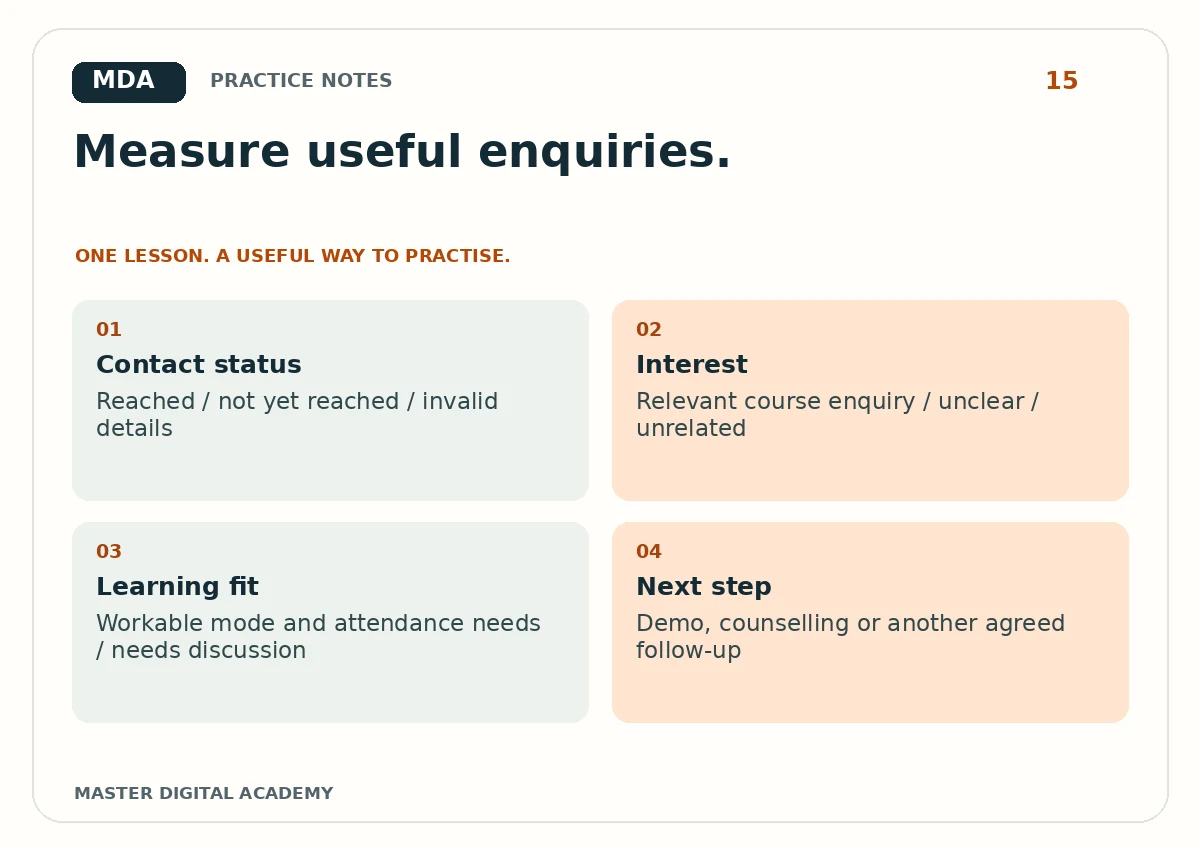
- Contact status
- Reached / not yet reached / invalid details
- Interest
- Relevant course enquiry / unclear / unrelated
- Learning fit
- Workable mode and attendance needs / needs discussion
- Next step
- Demo, counselling or another agreed follow-up
Try it yourself
Create ten fictional enquiries with varied contact and interest situations. Have two people classify them independently. Compare the differences and improve your definitions until the decisions become explainable. Calculate raw and qualified-enquiry cost for two sample campaigns. Present both metrics, the qualification rules and the unknown-record count. Your report should help an admissions team decide what to follow up, not simply celebrate the lowest cost in a chart.
Questions learners ask
Is an unreachable enquiry automatically unqualified?
No. Keep contact status separate until there is enough information to assess fit.
Should qualification happen automatically?
Use automation to organise information, but keep ambiguous decisions available for human review.
Keep learning
Further reading: Google Analytics: avoid sending personal information.