
Analytics · Practical learning
UTM Naming Conventions: Make Campaign Links You Can Actually Compare
Use a simple campaign naming sheet to keep sources, mediums and creative versions consistent across shared links.
A campaign report becomes confusing when one link says Instagram, another says instagram and a third says insta. A naming convention prevents those variations before they reach a report. UTMs add campaign information to links so analytics can identify the traffic more usefully. They are not a magic way to track every sale or bypass privacy settings. This exercise creates a small naming system for a fictional academy demo campaign and tests the final destination before anyone shares it.
Decide what each field means
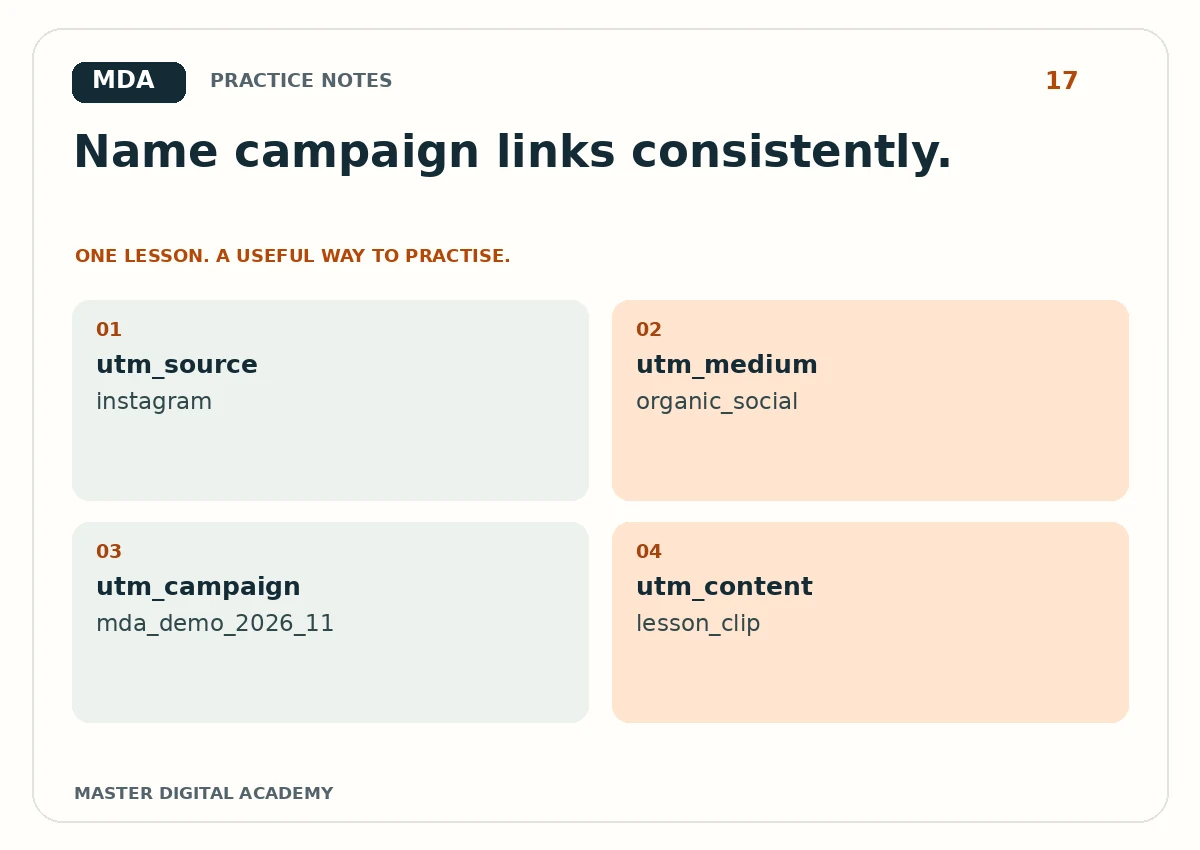
Use source for the specific origin, medium for the channel type and campaign for the shared initiative. A demo campaign may appear in an email and a social post while retaining the same campaign name. Define the meanings in your sheet so another person can create a link consistently. Avoid putting the same word in every field. Good naming is a coordination task: the values should help you compare activity without requiring the original link creator to explain every row.
Choose readable, stable values
Use a consistent case and separator, such as lowercase words joined by underscores. This is a team convention rather than a universal platform requirement. Keep names descriptive enough to recognise later. “demo_nov” may be less clear than a name that includes the relevant year or programme when the campaign is repeated. Do not rename live campaign links casually after distribution; older links will continue to circulate. Record approved values and their meaning in one shared place.
Use content to distinguish the actual variation
If two posts promote the same demo, a content value can identify the variation, such as lesson_clip or curriculum_card. Choose a label that describes something observable. Avoid calling every version “best” or “final,” because those names lose meaning when the next version appears. You can then ask whether the variations brought different visits or enquiries. Remember that the report’s value depends on a suitable measurement setup and enough context, not just the existence of five parameters in the URL.
Keep campaign parameters off internal navigation
Use campaign tags for appropriate incoming campaign links. Adding them to ordinary links between pages on your own website can make attribution harder to interpret. The internal journey can be measured through page and event data instead. Never put names, emails, phone numbers or other personal details in the parameters. Links may appear in browser history, logs and shared messages. A campaign naming sheet should include this rule explicitly so convenience does not introduce unnecessary data exposure.
Test the full URL before sharing
Open the completed URL and confirm it reaches the intended page. Check existing query strings and fragments rather than appending a second question mark blindly. Copy the link through the actual channel you plan to use and inspect the destination again. Record the final URL in the campaign sheet. If a link shortener or redirect is involved, verify that the parameters survive. A thirty-second check can prevent an entire campaign from sending people to an error page or producing unusable attribution.
Worked example
- utm_source
- utm_medium
- organic_social
- utm_campaign
- mda_demo_2026_11
- utm_content
- lesson_clip
- Destination
- The actual demo enquiry page, checked after tagging.
Try it yourself
Create six links for one campaign: two social variations, two email placements and two partner placements. Write the naming rules before building the URLs. Use the academy’s UTM builder to check formatting, then open every completed link. Ask someone else to create a seventh link using only your rules. If they invent a new spelling for an existing value, improve the naming sheet. Keep the worksheet as a reusable operations sample.
Questions learners ask
Do UTM parameters improve search rankings?
They are for campaign identification, not a ranking tactic.
Can I put a learner’s email in a campaign link?
Do not include personal details. Use non-personal campaign labels.
Keep learning
Further reading: Google Analytics: campaign URL builders.