
Websites · Practical learning
Build a Landing Page Wireframe: A Beginner Example From Headline to Form
Plan a focused enquiry page with a clear offer, useful evidence and a working form, using a fictional service example.
A landing page wireframe is a rough plan of what appears on the page and why. It should make the visitor’s next decision easier before colours, animations and photographs take over the discussion. In this exercise, ClearHome wants sofa-cleaning quotation requests. The page has one main job: help a suitable visitor understand the service and send enough information for a sensible response. You can create the wireframe on paper, in a slide or in a design tool. The thinking matters more than the software.
Connect the headline to the visitor’s task
A person clicking an ad for sofa cleaning should immediately see a matching service explanation. “Transforming lives through innovation” does not help. Try a direct heading such as “Ask about sofa cleaning for your home.” Follow it with the service area and how quotations work, if those details are confirmed. The opening should establish relevance without inventing a price or a guaranteed result. If the ad mentions a specific offer, show the same offer and its meaningful conditions on the page.
Place decision information before decorative sections
List the questions a suitable visitor needs answered: what is cleaned, which areas are served, how the quotation is prepared and what happens after enquiring. Give those questions clear positions in the wireframe. Real photographs and a short process can help, but they should serve the explanation. A long carousel of vague benefits may push practical information too far down the page. When reviewing the layout, ask what decision each section supports rather than whether it simply fills an empty space.
Use evidence that belongs to the business
A genuine before-and-after example needs accurate context and permission where appropriate. A review should retain its source and meaning. If you only have a stock photograph, it can illustrate the subject but cannot prove service quality. Write “evidence needed” in your private design notes instead of publishing a fabricated customer story. The final page should contain substantiated material or a simpler honest explanation. Your portfolio wireframe can show the evidence request alongside the proposed section.
Design the form and its response together
Ask for the information needed to respond, not every possible customer detail. Name, phone, area and a brief requirement may be enough for a quotation request. The exact fields depend on operations. Specify validation, loading, success and error states. A successful-looking message must follow confirmed saving or delivery. If the fallback opens WhatsApp, the visitor still needs to send the message there. These states belong in the wireframe because they are part of the experience, not an invisible development detail.
Review on a narrow screen first
Draw the page at a mobile width and read it from top to bottom. Can the headline be understood without a huge wall of text? Are the form labels visible? Can someone tap the main action without hitting another control? Check that floating chat buttons do not cover form fields. The final website also needs real-device testing, because a tidy design file does not prove browser behaviour. Keep the mobile version beside the desktop wireframe rather than treating it as a later resize task.
Worked example
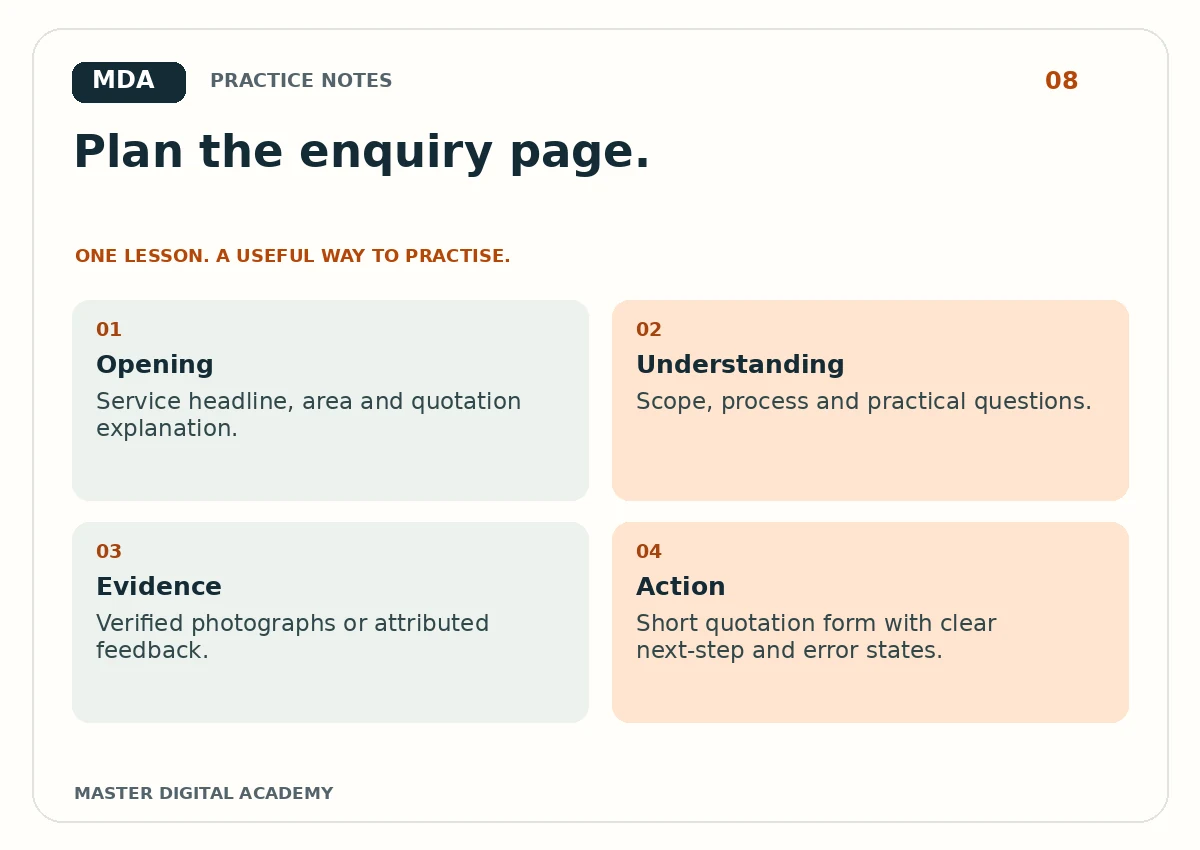
- Opening
- Service headline, area and quotation explanation.
- Understanding
- Scope, process and practical questions.
- Evidence
- Verified photographs or attributed feedback.
- Action
- Short quotation form with clear next-step and error states.
Try it yourself
Create a one-page mobile wireframe and annotate every section with its purpose. Write the exact headline, form labels and success message. Add two evidence requests for the business owner. Ask a friend to find the quotation action and explain what happens after submission. If they expect an instant confirmed booking but the business only offers a callback, rewrite the action and confirmation. That correction is a valuable part of the exercise.
Questions learners ask
Does a landing page need only one link?
No. It needs a focused main action, while useful navigation, policy and supporting links may still be appropriate.
Can I practise without spending on ads?
Yes. Build and test the page journey first. Paid traffic is not required to learn wireframing.
Keep learning
Further reading: Google Ads: relevance and landing-page experience.