
Measurement · Practical learning
Build a Marketing Budget Forecast Without Inventing Results
Use clear assumptions to estimate clicks, enquiries and qualified leads, then test how fragile the forecast is.
A forecast is a set of assumptions written clearly enough to challenge. It is not a promise disguised as a spreadsheet. If you do not have account history, say so and use scenarios to show what different costs and conversion rates would imply. This lesson uses a fictional monthly test budget of ₹15,000. The numbers are teaching assumptions, not market benchmarks for a city, course or industry. The useful skill is tracing how one assumption changes the outcome.
Define the result before dividing the budget
Decide whether the model is forecasting clicks, enquiries, qualified enquiries or sales. They are different stages. Write a definition for each and identify who will verify it. A form submission might be an enquiry, while a qualified enquiry meets agreed criteria. Sales depend on availability, follow-up and a customer’s decision. Do not hide those distinctions behind a single “leads” column. A forecast becomes easier to discuss when everyone understands the event being counted.
Start with a transparent arithmetic chain
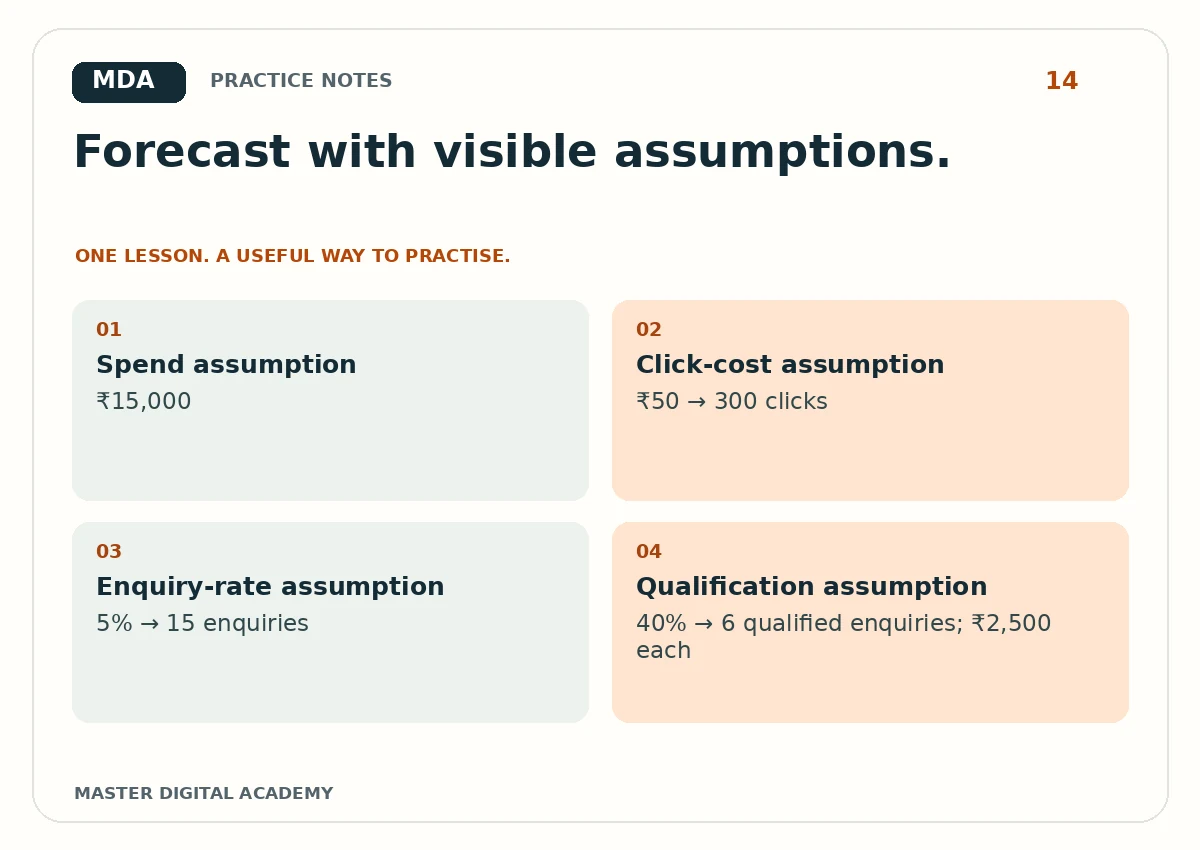
For this example, assume ₹15,000 in spend and ₹50 per click. The model produces 300 clicks. At a hypothetical 5% click-to-enquiry rate, that becomes 15 enquiries. If 40% qualify, there are six qualified enquiries. The arithmetic is simple; the uncertainty lies in whether those assumptions reflect reality. Label all three inputs and keep them editable. Do not copy a competitor’s claimed conversion rate and present it as your own expected performance.
Show more than one scenario
Create a cautious, middle and stronger scenario by changing the important inputs. If click cost rises to ₹75 while other assumptions stay unchanged, 200 clicks produce ten enquiries and four qualified enquiries. This shows why a single-point forecast can create false confidence. Avoid adjusting every variable in the favourable direction without explanation. A scenario is useful when it helps someone decide what to test or what budget risk they can accept, not when it merely makes a proposal look attractive.
Connect cost to business value carefully
Qualified cost alone does not determine profitability. The business also needs to consider close rate, revenue, delivery cost and capacity. These should come from the business rather than invented industry averages. If the owner cannot provide them, leave the value model incomplete and identify the missing inputs. That is more honest than calculating an impressive return from assumed sales figures. For a course project, a well-labelled gap shows that you understand where marketing estimates depend on operational evidence.
Update the model with measured evidence
After a controlled test, replace assumptions with observed figures while keeping the original forecast for comparison. Use sufficient time and context to interpret changes; a few clicks are not a stable benchmark. Check that the form and tracking worked before blaming the forecast. Record what changed in the audience, offer or follow-up process. A useful report says which assumptions held, which did not and what the next test should resolve. It does not quietly rewrite the original forecast to match the outcome.
Worked example
- Spend assumption
- ₹15,000
- Click-cost assumption
- ₹50 → 300 clicks
- Enquiry-rate assumption
- 5% → 15 enquiries
- Qualification assumption
- 40% → 6 qualified enquiries; ₹2,500 each
Try it yourself
Build a three-scenario sheet using the same ₹15,000 budget. Change click cost and enquiry rate independently, then explain which assumption most affects qualified-enquiry cost. Add a column showing where each input came from: account history, business data or teaching assumption. Finish with a short test plan and a maximum acceptable loss for the practice proposal. Keep forecast outputs visibly separate from actual campaign results.
Questions learners ask
Can a forecast be useful without market data?
Yes, as a scenario model with explicit assumptions. It should not be presented as a reliable performance prediction.
Should I promise a fixed number of leads?
Avoid promising an outcome that depends on unverified costs, conversion rates and follow-up conditions.
Keep learning
Further reading: Google Ads: conversion tracking.