
Google Ads · Practical learning
Write Better Search Ad Assets: A Practical Beginner Copy Exercise
Write complementary search-ad headlines and descriptions around a verified offer, with a complete practice message set.
Writing search ads is an exercise in making a useful promise with very little space. Beginners often write five versions of “best service” and assume the job is finished. A better asset set gives the system distinct, accurate ways to explain the offer. In this lesson, a fictional sofa-cleaning business wants quotation enquiries. We will create messages about the service, practical information, evidence and next action. Actual asset limits and platform settings should be checked before uploading the work.
Write the verified offer first
Describe the service and the next step in a complete sentence: visitors can request a sofa-cleaning quotation for their area and sofa type. Confirm what the business can actually offer before drafting anything shorter. If prices, availability or methods are not confirmed, leave them out. Ad copy should not create a promise that the landing page or team cannot fulfil. Your private brief can list missing information for the owner to answer before the campaign is considered ready.
Give headlines different jobs
Draft some headlines that identify the service, some that address a useful question and some that invite an action. Avoid making every line depend on another line appearing beside it. Responsive formats can combine assets in different arrangements, so messages should remain understandable in plausible combinations. Read them aloud together to catch repetition. “Sofa Cleaning Service,” “Cleaning for Sofas” and “Get Your Sofa Cleaned” provide less variety than a set that also explains quotation and booking expectations.
Use descriptions to clarify rather than inflate
Descriptions can explain the process, the information needed and what happens after enquiry. A helpful line might ask the visitor to share their area and sofa details for a quotation. Do not replace specificity with “unmatched excellence” or “guaranteed satisfaction” unless the claim has a meaningful, substantiated basis. Simple language usually makes review easier because every promise is visible. It also helps the business owner check whether the message matches the service they are prepared to deliver.
Check the landing page beside the assets
Place the page screenshot next to your ad worksheet. Underline each ad claim and locate its support on the page. If the ad says “book today” while the form only requests a callback, clarify the action. If the page describes a different service, fix the destination. This comparison is more useful than judging copy in isolation. A high-interest message can still waste money if it attracts the wrong expectation or sends visitors into an incomplete enquiry journey.
Create a feedback plan for the first test
Decide what would make an asset set useful: relevant enquiries, suitable questions and a reliable path to a response. Click-through rate can help interpretation, but it does not establish commercial success. Keep a dated version history and avoid changing every message after a handful of impressions. In a student project, present the proposed test and the uncertainties. Do not invent a performance chart for an unlaunched campaign. A clear explanation of how you would learn is a credible deliverable.
Worked example
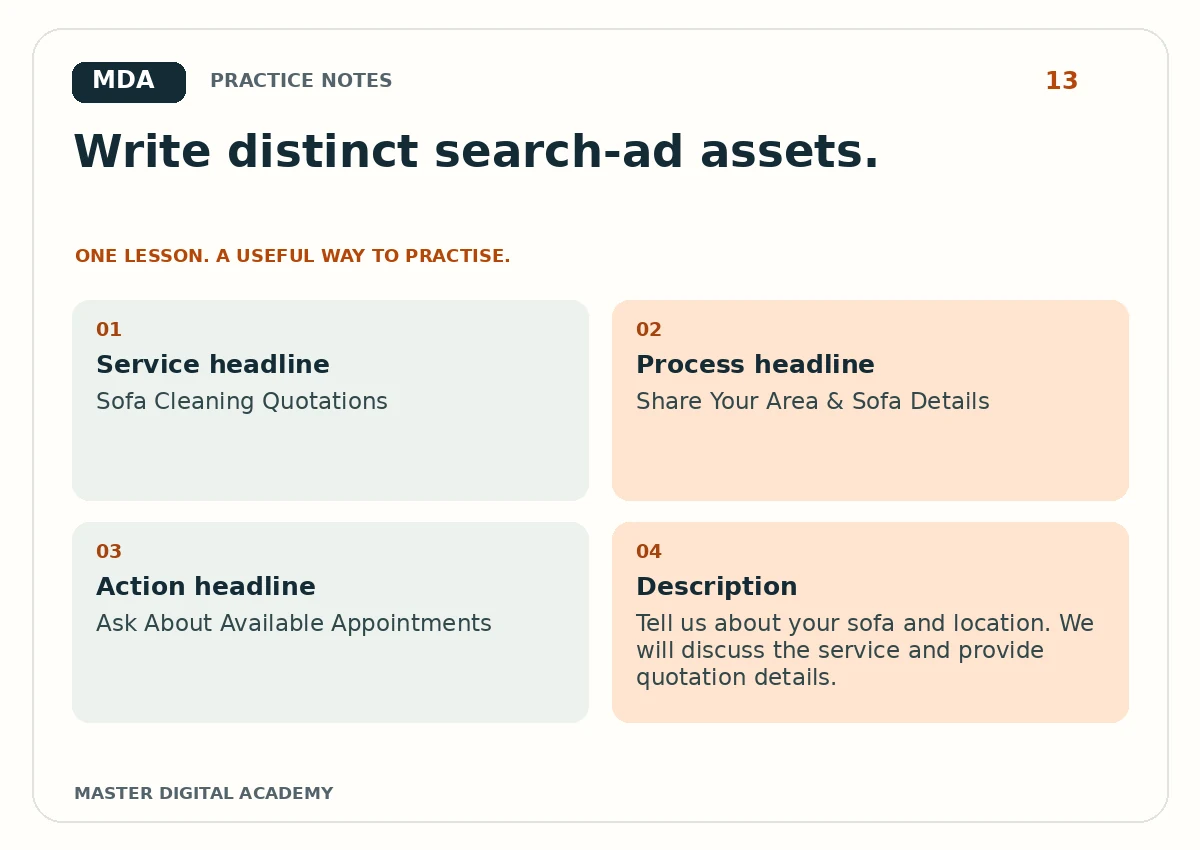
- Service headline
- Sofa Cleaning Quotations
- Process headline
- Share Your Area & Sofa Details
- Action headline
- Ask About Available Appointments
- Description
- Tell us about your sofa and location. We will discuss the service and provide quotation details.
Try it yourself
Write eight distinct headline ideas and three descriptions. Label each as service, evidence, question or action. Create six plausible combinations and remove repetitions or misleading joins. Check current platform limits, spelling and landing-page support before presenting the final set. Add a short note explaining one message you rejected and why. That shows judgement, which matters more than generating the largest possible pile of variations.
Questions learners ask
Should I use AI for search-ad variations?
It can help draft alternatives, but you must verify every promise, combination and platform limit.
Does a strong ad guarantee a strong campaign?
No. The offer, targeting, destination, measurement and response process all affect results.
Keep learning
Further reading: Google Ads: responsive search ads.