
Reporting · Practical learning
A One-Page Weekly Marketing Report That Explains What to Do Next
Turn campaign counts into a concise report with evidence, lead quality, limitations and one prioritised next action.
A weekly report should help someone decide what to do next. A page full of charts can still fail that job if nobody knows what changed, why it matters or whether the enquiries were useful. This exercise creates a one-page report for a fictional academy campaign. It uses a small set of consistent numbers and a short action note. You can build it in a document or spreadsheet. The format matters less than the clarity of the definitions and the honesty of the interpretation.
Lead with the decision the report supports
Write the business objective at the top: assess whether the current campaign is producing suitable demo enquiries within the agreed test budget. This keeps the report focused. If the objective is classroom admissions, broad social reach cannot become the main success claim simply because it looks large. Include the dates and the source of the numbers. When a figure comes from admissions rather than an ad platform, label it. Mixing sources is acceptable when the relationship and limitations are explained.
Show counts before conclusions
Include spend, visits or clicks, confirmed enquiries, qualified enquiries and the relevant cost measures. Keep unknown outcomes visible. If admissions has not assessed half the records, the report should not imply that all unassessed records are poor quality. Compare against a suitable previous period while noting any major budget or tracking changes. Avoid a dramatic percentage headline when the movement is from one enquiry to two. Small counts deserve plain explanations rather than oversized green arrows.
Separate observations from explanations
“Enquiries increased from 12 to 18” is an observation. “The new headline caused the increase” is an explanation that needs evidence. Other changes may have happened at the same time. Write likely explanations as hypotheses and describe what would help test them. A practical report can still recommend action without claiming certainty. This distinction is especially useful for beginners because it stops a confident writing style from disguising incomplete analysis.
Choose one primary next action
A report that recommends changing the audience, landing page, offer and follow-up together may be difficult to learn from. Pick the most important problem supported by the evidence. For example, if test records show the form failed on mobile, fixing it comes before judging creative variations. Give the action an owner and a success check. Keep secondary ideas in a backlog. The report becomes an operational tool when someone can identify what needs to happen after reading it.
Close the loop in the next report
Carry the previous action forward and record its outcome. Was the form fixed? Was the tracking checked? Did admissions complete qualification? Without this step, weekly reports can repeat the same recommendations indefinitely. Keep the report short enough to read in a few minutes, with detailed worksheets available separately. A useful report makes the work inspectable: another person should be able to follow the numbers, see what remains uncertain and understand why the next action was selected.
Worked example
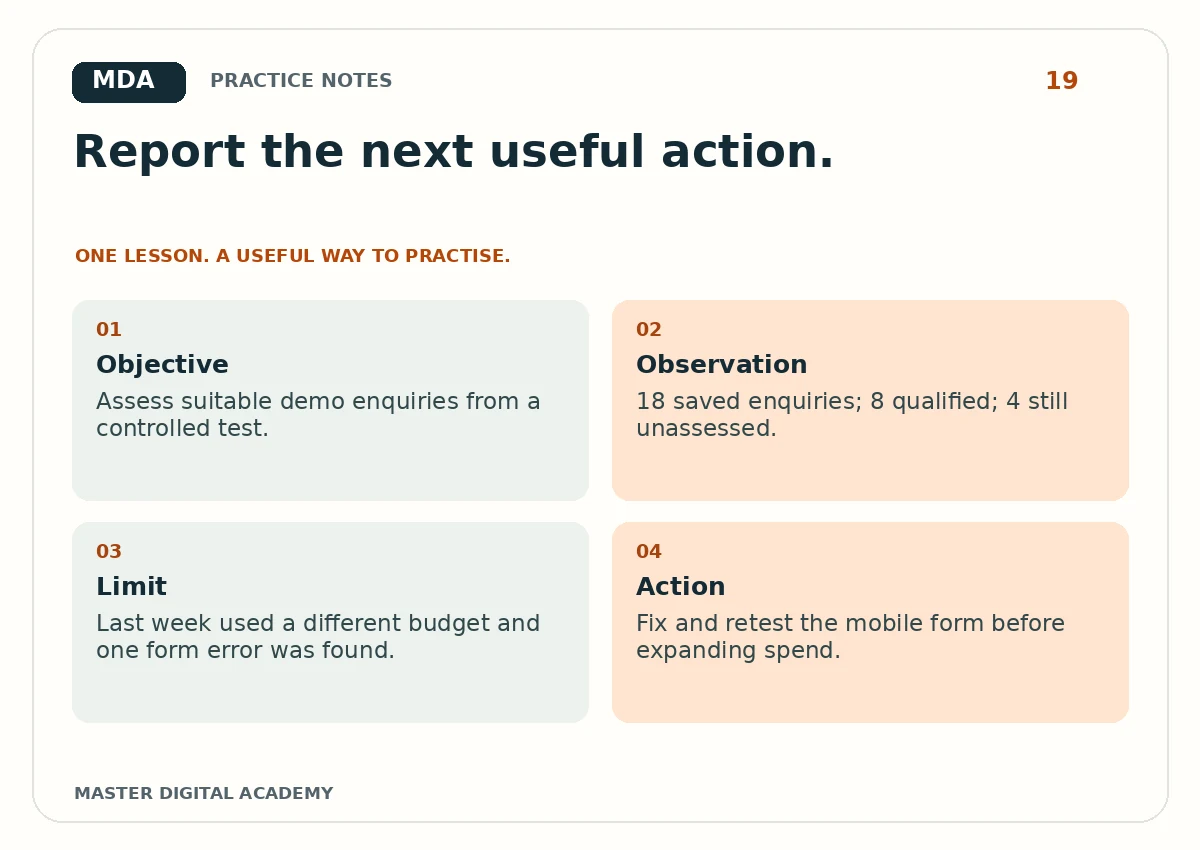
- Objective
- Assess suitable demo enquiries from a controlled test.
- Observation
- 18 saved enquiries; 8 qualified; 4 still unassessed.
- Limit
- Last week used a different budget and one form error was found.
- Action
- Fix and retest the mobile form before expanding spend.
Try it yourself
Create a one-page report using fictional data for two weeks. Include six counts or metrics, one tracking limitation, one admissions insight and one primary action. Underline sentences that claim cause and effect and check whether your data supports them. Ask a reader to name the next action in ten seconds. If they cannot, reduce the number of competing recommendations and make the owner and success check more explicit.
Questions learners ask
Should every report include every platform metric?
No. Include what helps assess the objective and diagnose the next useful action.
Can I use AI to write the report?
Use it to organise verified figures, then check calculations, definitions and every explanation before sharing.
Keep learning
Further reading: Google Analytics: overview reports.